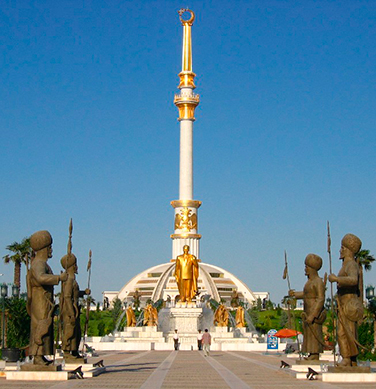
Independence Monument
Independence Monument
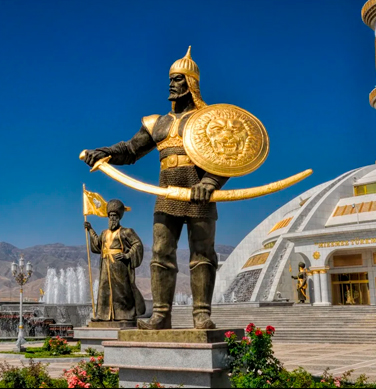
The monument is a 118-meter column topped with a gilded crescent with five stars - a symbol of the unity of the five largest Turkmen tribes, the lower part of the monument is a hemisphere resembling a traditional Turkmen yurt.
The building houses the "Museum of Independence", which displays historical exhibits related to the origins of the country's sovereignty.
An integral part of the Independence Monument of Turkmenistan is the ceremonial pedestrian alley, at the very beginning of which a gilded figure of the first president of Turkmenistan, Saparmurat Niyazov, is erected on a marble pedestal, and the monument is also surrounded by 27 sculptures of national heroes.
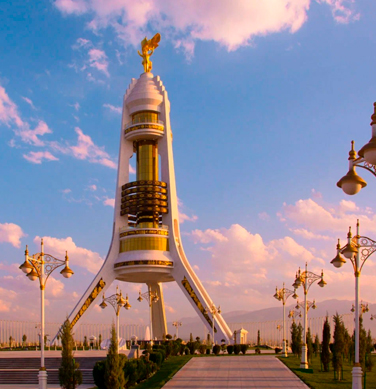
Arch of Neutrality
The arch was built in 1996-1998 by order of Saparmurat Turkmenbashi. It was built by the Turkish company Polimeks and ceremonially opened on December 12, 1998
Three widely spreading pylons support this multi-level structure 83 meters high, crowned with a twelve-meter gilded sculpture of the President of Turkmenistan Saparmurat Turkmenbashi against the background of a fluttering flag. Before its transfer, this entire composition slowly rotated in the direction of the sun and made a full rotation around its axis in 24 hours. The axis of the entire structure is a panoramic elevator leading to several circular observation platforms, from where a view of the capital opens up.
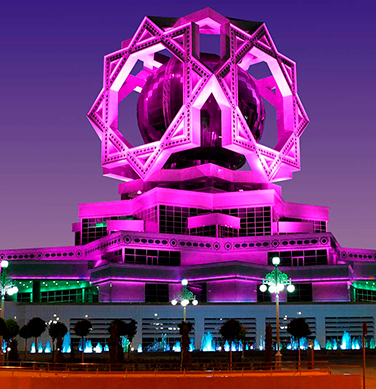
Turkmenbashi Palace of Happiness (Wedding Palace)
The largest family holiday of the Turkmen - the wedding toi - over the centuries "overgrown" with a large number of components and attributes, a mass of rituals that have entertaining, playful, ethical and educational significance. They include various rituals - matchmaking, processions for the bride, her exit from the parental home, transfer to the groom's house, etc., as well as accompanying comic scenes, wedding dances and songs. Clothing, especially women's clothing, played a significant role here, the symbolism of which was given special significance. In the old days, the wedding costume was closely associated with magic, performing various functions, including amulets and purification.
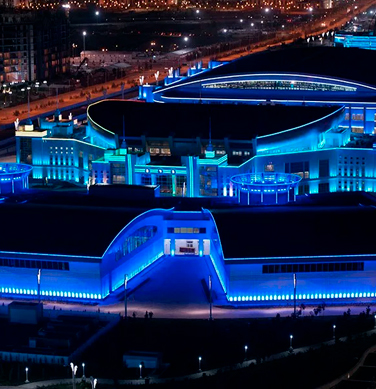
Ashgabat Olympic Complex
The construction began in late 2010, when on November 5, President of Turkmenistan Gurbanguly Berdimuhamedov took part in the ceremony of laying the foundation stone of the Olympic Village. The unique facility, which has no analogues in the Central Asian region, became the venue for the Asian Indoor Games, it included more than 30 facilities for various purposes, including the Olympic Stadium, the Paralympic Complex and the rehabilitation medical center. The initiator of the construction is the President of Turkmenistan Gurbanguly Berdimuhamedov. The opening and closing ceremonies of the games, all competitions, as well as the award ceremonies for the winners were held there.
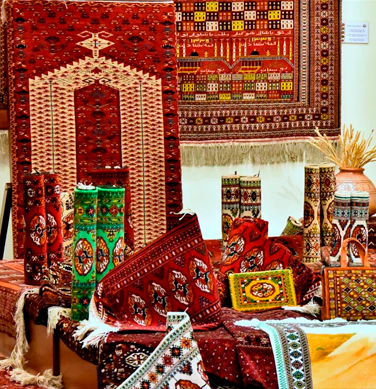
Carpet Museum of Turkmenistan
The National Carpet Museum is located in the very center of Ashgabat, has an area of 15 thousand square meters, a third of which is allocated for a permanent exhibition. The museum's collection includes 2,000 exhibits from various eras, but mainly from the 17th-19th centuries. There is also the smallest carpet in the form of a key holder, and the largest, which was even included in the Guinness Book of Records - its area is 301 square meters. In the halls of the National Carpet Museum, you can also get acquainted with the types of carpets and their use in traditional life, because carpets were used for prayers, for holidays, to decorate a yurt, etc. Among the exhibits there are machines and objects for work, which will allow you to understand how complex and painstaking the process of manual work is.
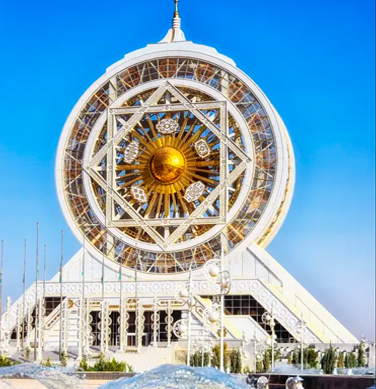
Alem Park and Ferris Wheel
The complex is strategically located next to the monumental Constitution Monument, the second tallest structure in Turkmenistan, creating a dramatic architectural contrast. The area in front of Alem is decorated with a spacious plaza with numerous fountains, highlighting the grandeur of the setting.
Inside Alem, visitors are greeted by six levels of varied entertainment. The complex includes bowling alleys, karaoke rooms and video game rooms, offering a wide range of leisure activities. In addition, there are several cafes, a restaurant and special playgrounds for children, providing a comprehensive entertainment experience for all ages.
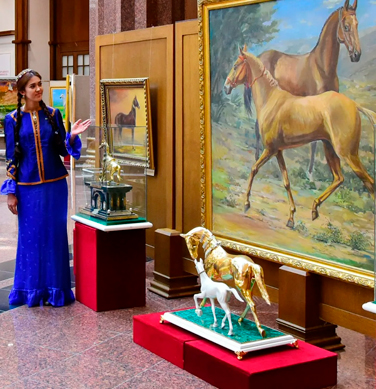
National Museum of History of Turkmenistan
Located in the capital Ashgabat, the National Museum of History and Ethnography of Turkmenistan is a leading institution dedicated to preserving and showcasing the country’s rich heritage. Founded in November 1998, the museum boasts a remarkable collection of over 500,000 artifacts spanning a variety of historical periods and themes. With nine separate halls, each dedicated to a different aspect of Turkmen history and culture, the museum offers an in-depth exploration of the country’s past.
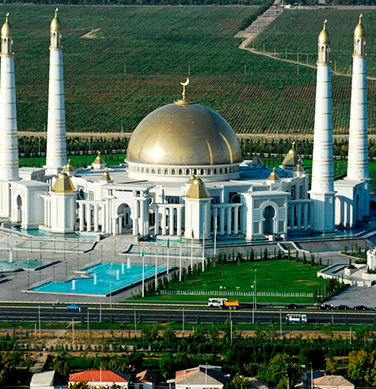
Geoktepe Mosque (Turkmenbashi Ruhy Mosque)
Its total area is 18 thousand square meters, the height of the building, built of white marble, is 55 meters, and the height of each of the four minarets is 91 meters, symbolizing 1991 - the year of Turkmenistan's independence. The mosque can accommodate 10 thousand believers, seven thousand men and three thousand women can pray at the same time [6]. The building has 8 more entrances, in front of each of which there are arched gates and cascades of fountains. The mosque has heated floors, which are made in the form of an eight-pointed star with a carpet of 215 square meters. On the territory of the mosque there are special rooms for ablutions and ritual events for 5 thousand people.
Independence Park
Well-groomed paths, marble staircases and porticos, flower beds and cozy benches - all the essential attributes of a recreation park are present here. But Independence Park is better known for the monuments located on its territory. Walking along the main alley past the five-headed eagle fountains and sculptures of national heroes, you will climb a wide marble staircase to the Independence Monument.
This 118-meter column, crowned with a crescent with five stars, symbolizes the unity of the five Turkmen tribes. The lower part of the monument is made in the form of a huge yurt, inside which is the Museum of Independence.
Park of Lights and Fountains "Oguzkhan"
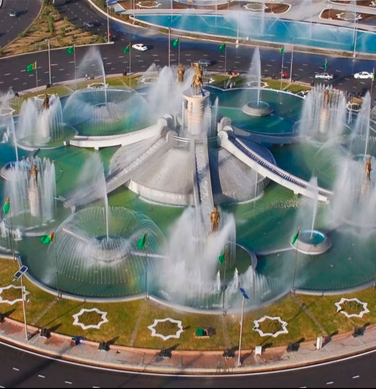
The architectural and sculptural ensemble depicts the legendary ancestor of the Turkic peoples, Oguzkhan, sitting with his hand raised on a horse in the center of the fountain, and his six sons: Gun-khan (lord of the sun), Ai-khan (lord of the moon), Yildiz-khan (lord of the stars), Gek-khan (lord of the sky), Dag-khan (lord of the mountains) and Dengiz-khan (lord of the sea). According to the Guinness Book of Records, the complex consists of 27 fountains located on an area of about 15 hectares. All of them are synchronized, illuminated and fully programmable [4]. The monumental composition was created by a creative team led by People's Artist of Turkmenistan Babasary Annamuradov.
The authors conceived the sculptural composition in such a way that it “symbolizes the peacefulness of the Turkmen people, their indestructible unity and cohesion, and at the same time the creative spirit and power of modern Turkmenistan.”
Kou-Ata Cave
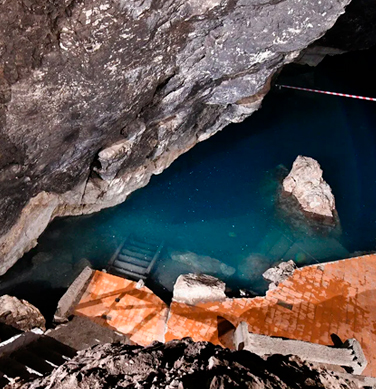
Kow-Ata (Kov-ata, Kyov-Ata, Turkmen Köw-ata, Bakharlyn underground lake[6], Bakharden lake, obsolete Durun, Kou, Bakharden) is a natural underground lake. The name translated from Turkmen means "father of the caves". It is located on the territory of Turkmenistan, in the Bakharden cave, 100 kilometers from Ashgabat. It is one of the tourist sites in the country. The total length of the cave in which the lake is located is 250 m, the lake itself is 75 m, the width of the lake is 8 m by 23 m, the depth is up to 12 m (14 m). Water temperature from +33 to +38 °C all year round
Kopetdag Mountains
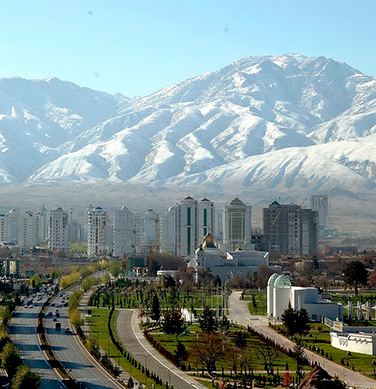
Kopetdag (from Turkic "many mountains"; Persian کپهداغ, Turkmen Köpetdag) is a large mountain system in Iran and Turkmenistan, part of the Turkmen-Khorasan Mountains. The length is about 650 kilometers, the height is up to 3117 meters. Parallel ridges, ranges and plateaus are divided by longitudinal and transverse valleys of the Atrek and Sumbar rivers.
The desert loess foothills are home to cheetah, leopard, jackal, striped hyena, Indian honey badger, porcupine. Herds of mountain Kopetdag sheep graze on high open plateaus, and bezoar goat in rocky gorges.
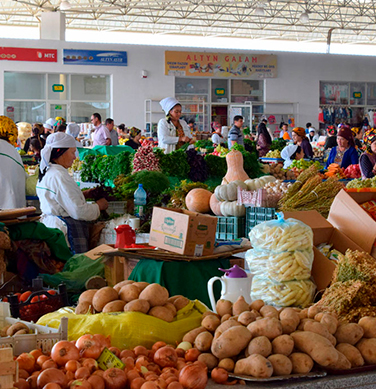
Bazaar “Altyn Asyr” (Tolkuchka)
The eastern bazaar "Altyn Asyr" ("Golden Age") (Turkmen: Altyn Asyr bazary) is the first largest market in Ashgabat and Turkmenistan, and the 5th in Central Asia. It is located in the suburbs of Ashgabat, in the residential area of Choganly. It is built in the form of a carpet gol of the Akhal velayat, a huge territory of 154 hectares. In the center of the bazaar is a high tower with a clock, the main landmark. There are 2,155 stores on its territory. It was built instead of the demolished Tolkuchka bazaar
Theaters of Ashgabat
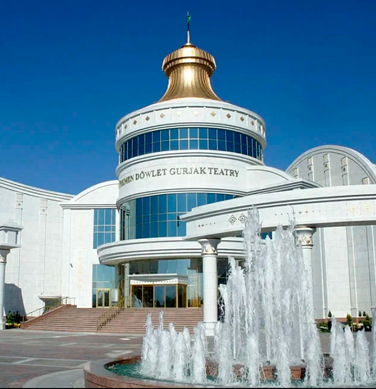
Main Drama Theatre named after Saparmurat Turkmenbashi the Great
National Music and Drama Theatre named after Makhtumkuli
Turkmen National Youth Theatre named after Alp Arslan
State Russian Drama Theatre named after A.S. Pushkin
Turkmen State Puppet Theatre
Student Theatre named after Mollanepes
Golden Tower of Ruhiet
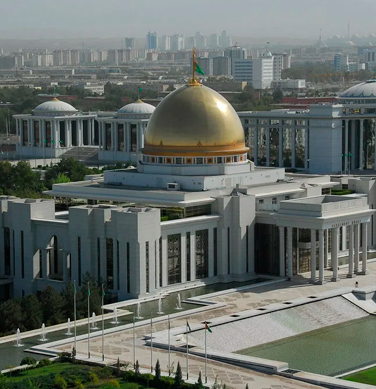
The Ruhiyet Palace of Congresses and Arts (Turkmen: Ruhyýet köşgi) is a palace in Ashgabat. The palace hosts official state events, forums, conferences, meetings, congresses, inaugurations, and concerts. The capacity of the interior spaces, their technical equipment, and comfort fully allow for holding and covering events at the highest international level. Along with official events, concerts, exhibitions, and festive celebrations are held here. The palace was built by the French company Bouygues.
The Ruhiyet Palace is decorated with a majestic giant carpet called the President (area of 294 m², size 14×21 m, weight 1t 105 g)